Non-infill synthetic turf for football fields is a response to the growing demand for environmentally friendly and cost-efficient sports infrastructure. Wovengrass, the world’s first woven sports surface without rubber granulate, combines durability, aesthetics and full recyclability. Discover modern microplastic-free fields that meet the expectations of investors, municipalities and facility managers seeking sustainable solutions.
What is non-infill turf and how does it work?
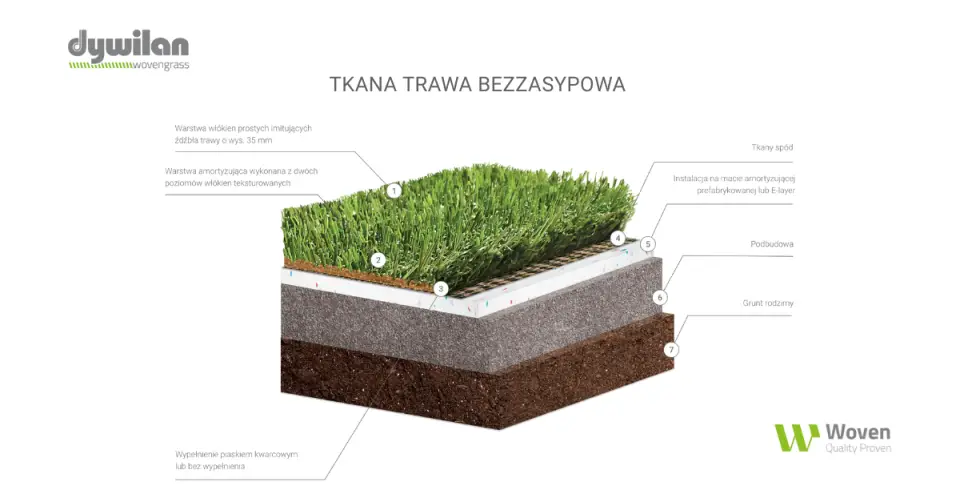
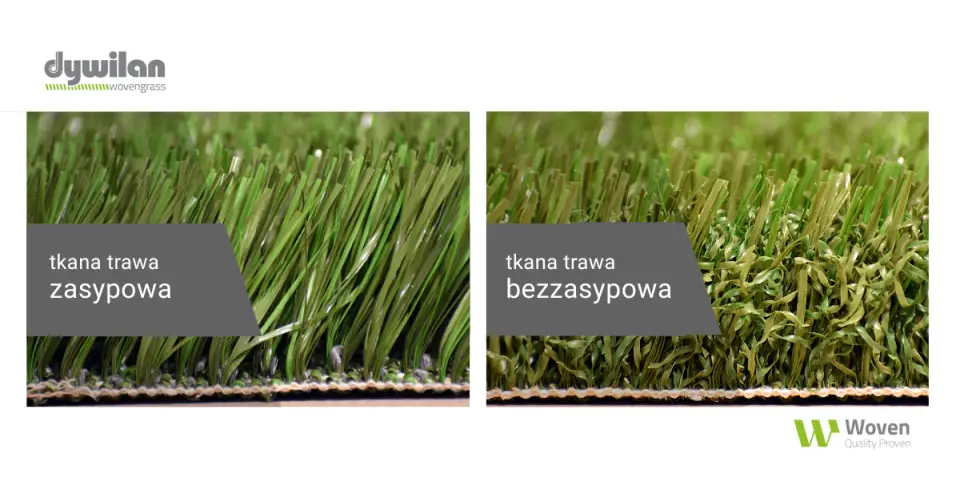
Non-infill synthetic turf is a modern sports surface that does not require rubber granulate. Instead, shock absorption is provided by specially textured fibers and an elastic layer (shockpad).
This solution eliminates the problem of infill migration beyond the field, reduces microplastic emissions and significantly simplifies maintenance. Compared to traditional 3G systems, non-infill turf is more environmentally friendly and offers more predictable maintenance costs.
Why more investors are choosing non-infill systems
Growing environmental regulations and ecological awareness are driving designers, municipalities and facility managers to choose 4G non-infill turf systems.
Benefits:
- No granulate = no microplastics
- No need for infill replenishment
- Lower cleaning and maintenance costs
- Aesthetic appearance all year round
- Improved user safety – no loose particles
Comparison of 3G infill turf vs 4G non-infill turf
|
Product feature |
3G Infill Turf |
4G Non-Infill Turf |
|---|---|---|
|
Infill |
rubber granulate + sand |
no infill, shock-absorbing fibers |
|
Ecology: |
potential microplastic emission |
minimal microplastic impact |
|
Maintenance: |
requires infill replenishment |
lower maintenance costs |
|
Playing comfort: |
dependent on infill condition |
consistent performance |
|
Recycling: |
requires material separation |
100% recyclable |
Dywilan Wovengrass woven technology – durability and aesthetics
Wovengrass by Dywilan is the world’s first woven artificial turf for sports fields. Unlike traditional tufted systems, fibers are interwoven into the backing in a “W” shape instead of being needle-punched into a “V” structure. This eliminates the need for latex backing.
As a result, the surface:
- is 100% permeable
- has very high tuft bind strength
- does not require thick adhesive layers
- maintains performance for 15–20 years
The weaving technology also allows for a natural grass look thanks to varied fiber shapes and shades.
Where non-infill turf works best
Wovengrass non-infill turf is ideal for:
- school and community fields
- municipal sports facilities
- training grounds
- football club fields
The system is installed on a shockpad, improving shock absorption, playing comfort and injury prevention.
Full Recycling – a sustainable surface for the future
Wovengrass 4G is not only free from granulate—it is also fully aligned with circular economy principles:
- made from one material group (polyolefins)
- 100% recyclable
- can be reprocessed into new products
This makes it a sustainable and ESG-compliant investment.
FAQ – Frequently asked questions
Is non-infill turf suitable for intensive use?
Yes. Thanks to woven technology and shock-absorbing fibers, it maintains durability and comfort even under heavy use.
What is the lifespan of Wovengrass turf?
With proper maintenance, it lasts approximately 15–20 years.
Is Wovengrass more expensive than traditional turf?
Initial costs may be slightly higher, but lower maintenance costs compensate over time.
Does it require special maintenance?
No. Without infill, there is no need for replenishment—only brushing and cleaning.
Summary – Why choose Wovengrass non-infill turf?
Non-infill artificial turf is the future of sports surfaces. Dywilan Wovengrass combines:
- durability and aesthetics through woven technology
- playing comfort and user safety
- lower maintenance costs
- full compliance with environmental standards
For municipalities, investors and designers, it is the ideal solution for future-ready sports fields—durable, safe and sustainable.
